June 16: Dahr Jamail interviewed nuclear industry expert Arnold Gundersen on the truth of Fukushima. See the whole article at Common Dreams.
Some excerpts:
"Fukushima is the biggest industrial catastrophe in the history of mankind"
"We have 20 nuclear cores exposed, the fuel pools have several cores each, that is 20 times the potential to be released than Chernobyl, new calculations show that within the first week of the accident, they released 2.3 times as much radiation as they thought they released in the first 80 days."
According to Gundersen, the exposed reactors and fuel cores are continuing to release microns of caesium, strontium, and plutonium isotopes, known as "hot particles".
"We are discovering hot particles everywhere in Japan, even in Tokyo," he said. "Scientists are finding these everywhere. Over the last 90 days these hot particles have continued to fall and are being deposited in high concentrations. A lot of people are picking these up in car engine air filters."
Radioactive air filters from cars in Fukushima prefecture and Tokyo are now common, and Gundersen says his sources are finding radioactive air filters in the greater Seattle area of the US as well.
In the US, physician Janette Sherman MD and epidemiologist Joseph Mangano published an essay shedding light on a 35 per cent spike in infant mortality in northwest cities that occurred after the Fukushima meltdown, and may well be the result of fallout from the stricken nuclear plant.
"The units are still emitting radioactive gases and an enormous amount of radioactive liquid. It will be at least a year before it stops boiling, and until it stops boiling, it's going to be cranking out radioactive steam and liquids."
In reaction to the Fukushima catastrophe, Germany is phasing out all of its nuclear reactors over the next decade. In a referendum vote this Monday, 95 per cent of Italians voted in favor of blocking a nuclear power revival in their country. A recent newspaper poll in Japan shows nearly three-quarters of respondents favor a phase-out of nuclear power in Japan.
Why have alarms not been sounded about radiation exposure in the US?
Nuclear operator Exelon Corporation has been among Barack Obama's biggest campaign donors, and is one of the largest employers in Illinois where Obama was senator. Exelon has donated more than $269,000 to his political campaigns, thus far. Obama also appointed Exelon CEO John Rowe to his Blue Ribbon Commission on America's Nuclear Future.
Friday, June 17, 2011


Thursday, June 9, 2011
The New-Economy Movement
Gar Alperovitz, The Nation, 6/13/11:
"The idea that we need a “new economy”—that the entire economic system must be radically restructured if critical social and environmental goals are to be met—runs directly counter to the American creed that capitalism as we know it is the best, and only possible, option. Over the past few decades, however, a deepening sense of the profound ecological challenges facing the planet and growing despair at the inability of traditional politics to address economic failings have fueled an extraordinary amount of experimentation by activists, economists and socially minded business leaders. Most of the projects, ideas and research efforts have gained traction slowly and with little notice. But in the wake of the financial crisis, they have proliferated and earned a surprising amount of support—and not only among the usual suspects on the left. As the threat of a global climate crisis grows increasingly dire and the nation sinks deeper into an economic slump for which conventional wisdom offers no adequate remedies, more and more Americans are coming to realize that it is time to begin defining, demanding and organizing to build a new-economy movement..."
An excellent and thorough survey of the various groups and organizations, and philosophies- in the "New Economy" movement, by Gar Alperovitz - read the full report at TheNation.com
Sunday, May 29, 2011
Amazon Defenders: more killings
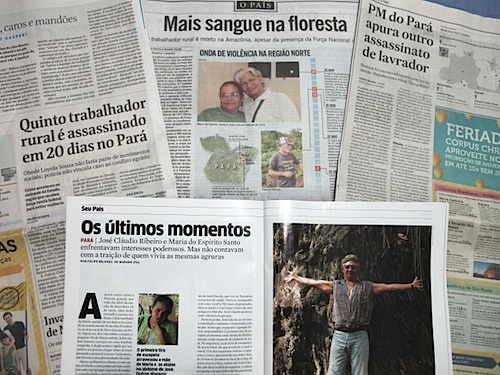
Amazon forest defender José Cláudio Ribeiro da Silva and his wife, Maria do Espírito Santo, were killed in an ambush near their home in May.
May 30: Another defender killed: Adelino Ramos
More Al Jazeera Amazon coverage
Friday, May 27, 2011
Captain McKibben: This is a Taste of the Future
Bill McKibben discusses this year's extreme weather with Juan Gonzales and Amy Goodman, May 27, 2011.
Related: 2011 Tornado Outbreak and Climate Change - at Ecoversity.org
Wednesday, May 25, 2011
A New Kind of Long Disaster
 |
| Joplin, Missouri, chipped by an F4 multivortex tornado May 2011 |
Consider the BP oil spill and the Fukushima nuclear meltdowns which followed the megaquake and tsunami: while both were caused by a single improbable event, in both cases the disaster was ongoing and accumulated for many months.
Tornadoes on the other hand generally make for very short-lived disasters- it's all over in a few minutes, and the damage is very local. But this year it's different. We are in the midst of multiple waves of tornado outbreaks, well over 1000 so far, with now over 500 dead and many towns destroyed. And these are big ones- a half-mile or more on the ground, up to 60,000 feet high, 'multi-vortex' wedge tornadoes with 200 mph winds- enough to destroy a town, and even strip the bark from the shattered trees. As I write this on May 25, I'm watching MSNBC live coverage of softball size hail and large tornadoes stalking Dallas and Oklahoma City, and now, a little later, Memphis.
The same weather pattern, of hot humid air rising from the Gulf meeting arctic air riding down from the north on the jet stream, is predicted to continue for several more weeks. Tornadoes are expected tonight, tomorrow, and until the pattern breaks. So we're in the midst of another kind of 'long' disaster, a weather disaster.
Related:
"Across the nation and the planet, unprecedented extreme weather events are on the rise.
Last year, the Federal Emergency Management Agency declared a record 81 disasters, almost three times the average seen over the past 60 years, leading to $6.7 billion in total damages. Munich Re, one of the largest reinsurers in the world said, “The only possible explanation for the rise in weather-related catastrophes is climate change.”
- Climate change makes extreme weather normal ________
"The last two months have been a whirlwind, sometimes literally, of wild weather: The deadliest tornado outbreak since 1932, levels of flooding unseen since the Great Depression. But as Texas’ eastern neighbor, Louisiana, finds itself ankle-deep in water rushing down from the diverted Mississippi River, the Lone Star state is immersed in a climate crisis of its own, complete with months of bone-dry land and thousands of raging wildfires."
- Texas Wildfires: Months Of Flames, Drought Devastate The Lone Star State
______________
"The nation’s scientific establishment issued a stark warning to the American public on Thursday: Not only is global warming real, but the effects are already becoming serious and the need has become “pressing” for a strong national policy to limit emissions of heat-trapping gases."
- Scientists’ Report Stresses Urgency of Limiting Greenhouse Gas Emissions
Bill McKibben: "In Pakistan, Australia and now the center of the North American continent, we're getting a powerful taste of what global warming feels like in its early stages. . . "
-(McKibben, LATimes OpEd: 'Climate change and the flood this time')
Saturday, April 9, 2011
Our Lives Are Under Threat From Some of the Most Powerful and Richest Entities
By Naomi Klein and Bill McKibben:
Our Lives Are Under Threat From Some of the Most Powerful and Richest Entities- Here's How We Can Fight Back and Win
April 8, 2011.
Not for forty years has there been such a stretch of bad news for environmentalists in Washington.
Last month in the House, the newly empowered GOP majority voted down a resolution stating simply that global warming was real: they've apparently decided to go with their own versions of physics and chemistry.
This week in the Senate. . (read on. . . )
Obama's Energy Plan Fail
Control carbon emissions- cap-and-trade fails in the Senate
Expanded offshore drilling- BP disaster, 11 dead, 200 million gallons spilled the Gulf
"Clean coal"- Massey Energy mining disaster and corrupted regulators scandal
Boost natural gas production- fracking pollution scandals
Push nuclear energy, $54 billion in guarantees- one word: Fukushima.
All this as several of our traditional sources of oil in North Africa and the Middle East are in turmoil.
A couple years ago, I'm sure Obama's energy plan looked reasonable to those he consulted at the time. Neither he nor his advisors could have foreseen the string of calamities which have tainted these industries over the last year. Or could they have? Obviously he wasn't listening to the dire warnings of the many expert critics of each of these industries; since industry basically set the table, I'm sure they weren't invited. Too bad, because each item in the above list was predictable and had been predicted. So we are still playing catch-up.
Monday, March 21, 2011
The WaySeers Manifesto
"The Way, when expressed by the mind, is genius; when perceived through the eyes is beauty; when felt through the senses is grace; when allowed into the heart is love."
Wednesday, March 16, 2011
Monday, March 14, 2011
Japan: Several Nuclear Reactors in Meltdown
Four reactors may be in partial meltdown as of Monday March 14. Amy Goodman reports on the situation in Japan and the potential implication for American nuclear power plants.
Thursday, March 3, 2011
Wednesday, February 9, 2011
Sustainability: 4 Scenarios for the 21st Century
A report from the Tellus Institute: "The Century Ahead: Searching for Sustainability"
Download the full report in pdf format
Excerpted summaries of the four scenarios:
2.1. Market Forces: Market-centered Development
Market Forces is constructed as a future in which free market optimism remains dominant and proves well-founded. As population expands by 40 percent by 2050 and free trade and deregulation drive growth, the global economy expands over three-fold by 2050, eightfold by 2100. All economic figures in this paper are expressed in purchasing power parity (PPP) dollars, which takes account of national differences in the cost of living when converting to a common currency. The availability of sufficient resources- raw materials, land, water, energy- and the means of maintaining ecological resilience in such a huge economy are critical uncertainties. The challenge of satisfying bio-physical sustainability constraints would be compounded by the challenge of maintaining social and economic sustainability in a world of profound inequalities between rich and poor countries, and within each country. Instability and conflict could undercut the evolutionary dynamics of the scenario, triggering a descent of civilization toward a Fortress World or more chaotic outcomes.
2.2. Policy Reform: Directing Growth
Policy Reform assumes the emergence of a massive government-led effort achieves sustainability without major changes in the state-centric international order, modern institutional structures, and consumerist values. Strong and harmonized policies are implemented that, by redirecting the world economy and promoting technological innovation, are able to achieve internationally recognized goals for poverty reduction, climate change stabilization, ecosystem preservation, freshwater protection, and pollution control. The scenario meets tough stabilization targets for carbon dioxide emissions and, in rough compatibility with United Nations Millennium Development Goals, halves world hunger between 2005 and 2025 (then halves it again by 2050).
Policy Reform is designed as a backcast constrained to meet the objectives shown in Table 5. As total greenhouse emissions decline, growth continues in developing countries for two decades as redistribution policies raise incomes of the poorest regions and most impoverished people. Although such transfers have been debated at climate negotiations, with little success to date, our analysis indicates that a Policy Reform approach will require a deep and widespread commitment to economic equity. As poorer countries converge toward the living standards of richer countries, they accelerate investment in environmentally sustainable practices.
Implementing this grand policy program in the context of Conventional Worlds values and institutions would not be easy: intergovernmental efforts to address sustainability challenges over the past two decades have not succeeded. The Policy Reform path would require unprecedented political will for establishing the necessary regulatory, economic, social, technological, and legal mechanisms.
2.3. Fortress World: An Authoritarian Path
If the market adaptations and policy reforms of Conventional Worlds were to prove insufficient for redirecting development away from destabilization, the global trajectory could veer in an unwelcome direction. Fortress World explores the possibility that powerful world forces, faced with a dire systemic crisis, impose an authoritarian order where elites retreat to protected enclaves, leaving impoverished masses outside. In our troubled times, Fortress World seems the true business-as-usual scenario to many. In this dark vision, the global archipelago of connected fortresses seeks to control a damaged environment and restive population. Authorities employ geo-engineering techniques to stabilize the global climate, while dispatching- peace-keeping militia to multiple hotspots in an attempt to quell social conflict and mass migration. But the results are mixed: emergency measures and spotty infrastructure investment cannot keep pace with habitat loss and climate change, nor provide adequate food and water to desperate billions. In this kind of future, sustainable development is not in the cards, a half-remembered dream of a more hopeful time.
2.4. Great Transition: A Sustainable Civilization
In dramatic contrast, Great Transition envisions a values-led change in the guiding paradigm of global development. The transformation is catalyzed by the push-pull of deepening crises and the desire for a just, sustainable, and planetary civilization. A pluralistic transnational world order coalesces as a growing cultural and political movement of global citizens spurs the establishment of effective governance institutions. The new paradigm is rooted in a triad of ascendant values: human solidarity, ecological resilience, and quality of life. Less consumerist lifestyles moderate the growth thrust of Conventional Worlds scenarios, as notions of the good life turn toward qualitative dimensions of well-being: creativity, leisure, relationships, and community engagement.
Population stabilizes more rapidly than in other scenarios as more equal gender roles and universal access to education and health care services lower birth rates in developing countries. The world approaches a steady-state economy with incomes reaching about $30,000 per person by 2100, three times the current average. Although this figure is well below the $50,000 of Conventional Worlds, the egalitarian income distributions of Great Transition leave most people far better off, while the
improved social cohesion reduces conflict. In this deeply sustainable vision, crises still linger, but the world is able to confront them with enhanced institutions for reconciliation and cooperation."
Source: Tellus Institute: "The Century Ahead: Searching for Sustainability"
Tellus Institute website
Subscribe to:
Posts (Atom)